So, hello!
Uh, I'm Jenna and I'm pretty awkward. I am creating this blog for my Graphic Design class. This is my final class before I get to go job hunt in my field. So, wish me luck when that happens! For this class I am to be keeping a blog about the Late Modern Movement in Graphic Design.
DISCLAIMER: I'm not very good at social media and never quite got on board with the whole blog thing, or twitter, instagram, snapchat, whatever; I always forget about them, it's just not my thing -- but, I would really like to pass this class so I will figure it out. Do forgive sporadic posting though, like I said, I am not very good at keeping up with social media stuff. I like to think I'm pretty private so constantly updating the world on things about me or has to do with me in any way is very foreign so forgive me if this is the most awkward blog you see.
So now that, that is out of the way, let's get down to business, yes?
LATE MOD (1940-1970)
Most of the research comes to the conclusion that late modern design is: "mostly known for distorted geometric shapes and informal layouts, the only aspect of this style that isn't informal is the type, which was devoid of decoration". Others say "the late modern period was dominated by American innovations. Inspired by European avant-garde early modern approaches, American late modern artists widely applied the non-decorative approach of the modernists without the dogma. The result was a new simplicity that gained wide popular acceptance."
Uh, I'm Jenna and I'm pretty awkward. I am creating this blog for my Graphic Design class. This is my final class before I get to go job hunt in my field. So, wish me luck when that happens! For this class I am to be keeping a blog about the Late Modern Movement in Graphic Design.
DISCLAIMER: I'm not very good at social media and never quite got on board with the whole blog thing, or twitter, instagram, snapchat, whatever; I always forget about them, it's just not my thing -- but, I would really like to pass this class so I will figure it out. Do forgive sporadic posting though, like I said, I am not very good at keeping up with social media stuff. I like to think I'm pretty private so constantly updating the world on things about me or has to do with me in any way is very foreign so forgive me if this is the most awkward blog you see.
So now that, that is out of the way, let's get down to business, yes?
LATE MOD (1940-1970)
Most of the research comes to the conclusion that late modern design is: "mostly known for distorted geometric shapes and informal layouts, the only aspect of this style that isn't informal is the type, which was devoid of decoration". Others say "the late modern period was dominated by American innovations. Inspired by European avant-garde early modern approaches, American late modern artists widely applied the non-decorative approach of the modernists without the dogma. The result was a new simplicity that gained wide popular acceptance."
That's a lot of mumbo-jumbo to me, and I think it can be best said as: they went for function dictating its form and simplicity. It showed in not only the graphics that came out but the fashion, architecture and products. Simple styles to get the message. I have some pics to go along with the time.
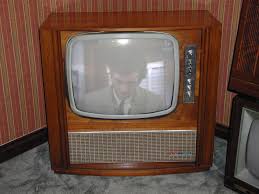
A perfect example of this would be the TV! The set design hasn't really changed that much, at all. Yes, now we have flat screens and wall mounts but the same exact basic style is there. Minimalist simplicity. Form dictating function. You know what did change? Advertising. When the TV became popular it changed the way we lived our lives and the way we advertised how to.
Another kinda reaching example would be the ships built, like the Titanic (I know that was in the early 1900's, think how elaborate it was) but think ships like the Queen Mary, HUGE MAMA-JAMMAS! But again, function dictating form and simplicity. Like, it's a ship...just don't let it get water on board and you'd be fine...it doesn't need a million freakin' staircases and gold plated dishes. Just make sure I'm alive from point A to point B...sorry, sometimes I rant.
A huge factor in what happened and inspired the Late Mod era, was WWII. We just won. So there was a new sense of pride. We defeated the evil Nazis. Which leads me to another great example of function and simplicity, which became "good design", the Italian Vespa. After the war ended a lot of material was in short supply: metals, fuels, etc. So the Vespa was cheap, reliable, easy to take care of and easy to drive. Perfect form and function.
So, I think I'll leave it here for now. I'll try and post again in a few days about the fashion or something. Below there are some pictures for your viewing pleasure.
I also used the ever handy-dandy Google to come up with material.

Vespa's are super cool.
 I just think it looks like a microwave. Am I the only one seeing this?

even though this was cancelled due to WWII, I still think this is beautiful. It's simple, it's clean, it's right there. Nothing fancy. ...I also love the font.
A perfect example of this would be the TV! The set design hasn't really changed that much, at all. Yes, now we have flat screens and wall mounts but the same exact basic style is there. Minimalist simplicity. Form dictating function. You know what did change? Advertising. When the TV became popular it changed the way we lived our lives and the way we advertised how to.
Another kinda reaching example would be the ships built, like the Titanic (I know that was in the early 1900's, think how elaborate it was) but think ships like the Queen Mary, HUGE MAMA-JAMMAS! But again, function dictating form and simplicity. Like, it's a ship...just don't let it get water on board and you'd be fine...it doesn't need a million freakin' staircases and gold plated dishes. Just make sure I'm alive from point A to point B...sorry, sometimes I rant.
A huge factor in what happened and inspired the Late Mod era, was WWII. We just won. So there was a new sense of pride. We defeated the evil Nazis. Which leads me to another great example of function and simplicity, which became "good design", the Italian Vespa. After the war ended a lot of material was in short supply: metals, fuels, etc. So the Vespa was cheap, reliable, easy to take care of and easy to drive. Perfect form and function.
So, I think I'll leave it here for now. I'll try and post again in a few days about the fashion or something. Below there are some pictures for your viewing pleasure.
I also used the ever handy-dandy Google to come up with material.
Vespa's are super cool.
even though this was cancelled due to WWII, I still think this is beautiful. It's simple, it's clean, it's right there. Nothing fancy. ...I also love the font.

No comments:
Post a Comment